Wednesday, May 19, 2010

for a graduating senior


Passport, 2010, 52" x 88"

This quilt has been patched together over a two-year period. An upcoming deadline finally got it to the finish line.

The recipient will be an innovative young man who always thinks outside the box. The African bug print at the top is a detail he’ll enjoy.

The global fabrics—from Africa, Japan, Southeast Asia and America— are from Maurine Noble’s stash. Nothing new there. Thank you Maurine!

Wednesday, May 12, 2010

fabric crush


Now in the Wallingford Center, Fabric Crush is the brightest fabric store I have ever been in. The designer fabrics–the lighting–the white-walled space with big windows–all combine to make a perfect shop for modern quilters.

The owner is Sarah Stine, a member of Plymouth Church and our Piecemakers group. Sarah has taken her vision and brought it to life. Go Girl!

Saturday, May 1, 2010

cabin gallery

At the top of the stairs at our log cabin is a set of pole railings. While I’m here, I hang a series of small quilts over the railings. Then I put the quilts away when I’m gone so they don’t get sun damaged.

This quilt is a gift from Maurine Noble who wrote the book Basic Quiltmaking Techniques for Machine Applique. Maurine made the quaint quilt to use in her applique classes that she taught around the world.

Monday, April 26, 2010

in situ


Two owners of baby quilts I made are using them in their living rooms as decorator accents—Pam’s is in her mid-century Ballard home and Naomi’s in her eclectic West Seattle. With both houses filled with art, the quilts look wonderful.

Friday, April 16, 2010

desert inspired


Michael and I are visiting Maurine Noble at her winter home in La Quinta, California. Maurine has a spacious and bright quilting room here. Her newest quilt top is a serene combination of pale batiks in a rotated and repeated pattern.

Monday, April 12, 2010

mina delivered


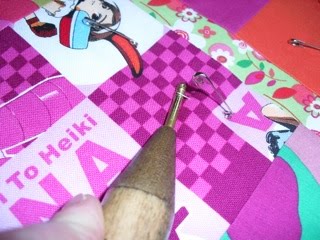
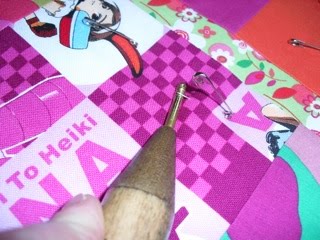
Mina to the Rescue, 2010, 43" x 55"
COLLECTION OF LOUISA CRYAN


Louisa is a huge soccer fan and a new convert to anime. I purchased the fabric for the Mina quilt in Tokyo, giving it an authentic Japanese pedigree. The backing fabric is a vivid green — as close to the Sounder’s green as possible.

Tuesday, April 6, 2010

at home in new zealand

My sister Janet lives in Wellington NZ. I’ve never visited yet she continually stops by my Northwest home.

This March she acquired African Night and Day, a lap quilt that’s now draped over a pumpkin arm chair in her living room. It looks great in her comfortable home.

Saturday, March 27, 2010

pinning the mina quilt

I worked this afternoon to pin together the Mina quilt sandwich. First I taped the green backing fabric to the berber carpet. Then I taped down the Warm & Natural batting. Next I placed the pieced layer on top.

I pinned the three layers together using a Kwik Klip (pronounced: quick clip), a simple tool that kept my fingers from being torn apart by the small sharp pins. I pushed each pin through the layers and onto the end of the Kwik Klip. Then I pulled up on the Kwik Klip to close the pins.
I started pinning from the middle of the quilt design. As I plan to in-the-ditch stitch, I kept the pins a short distance from all seams.
This is the back of the sandwich with the pins showing through.

Friday, March 19, 2010

the book i didn't write


Intuitive Color & Design, Jean Wells, 2009, C&T Publishing

This wonderful book, by Jean Wells, talks all about making quilts by taking an adventure. An Oregonian quilt artist, Jean articulates how to make color and design choices in a clear, straightforward way.

Inspired by Nancy Crow and Ruth McDowell, and decades of exploring her artistry, Jean presents a rich portfolio of quilt projects with encouraging commentary.

It’s the book I’d like to write in about ten years. Jean, thanks for beating me to it.

I bought the book at Fabric Crush—Seattle’s newest designer fabric store, now in the Wallingford Center.

Tuesday, March 9, 2010

my first commission


Royal Roots, 2010, 46" x 59"
COLLECTION OF BEVERLY ANDERSON


Last night I delivered my first quilt commission. Cindy Anderson, who bought a quilt from me in September, requested one for her mother-in-law’s birthday.

Cindy choose the fabrics out of my stash. The next time she saw the fabrics, they were in a finished quilt. (She mentioned to my sister that the quilt design wasn’t what she expected. That’s to be expected!)

The vintage plum and black fabric, given to me by Maurine Noble, is from South Africa. The central square is a highly detailed Indonesian batik. The gold and red batiks were bought at Lunn Fabrics in Lancaster, Ohio last summer.

The quilt is assembled using the quilt-as-you-go method with the red strips connecting the parts. The center is heavily hand-stitched while the background fabric is free motion machine-stitched.

Saturday, March 6, 2010

la conner connection


Quilts from the 08 Japanese show.

I drove to Skagit Valley today to meet Liz Theaker, the director of the La Conner Quilt & Textile Museum in the Gaches Museum. We talked about the upcoming Japanese show that opens the end of June.

In the summer of 08, I happened upon the biennual Japanese show (see photos above). The craftsmanship and design were impeccable. The quilts always come directly from Japan and don’t tour, so the show is exclusive to the Northwest’s only quilt museum.

In 2008, 14 quilters came to open the exhibit and teach classes. Liz doesn’t know yet how many quilters will be coming this year. No matter, they’ll be a big hit.

Monday, February 22, 2010

my mangle—an extinct beast

I bought my mangle, a.k.a. Kenmore automatic ironer, at an estate sale this winter for $12.50. I discovered it in a dank basement, probably left over from the early 50s.

Although it came with no instructions, the operation of my mangle is self-evident. Turn on to start heat. Push kneee pedal to make the roll go around. Push other knee pedal to engage the curved heated plate.

Recently I pre-washed some fabric for a lap-sized quilt project. When I pulled the damp fabric out of the washer, I pressed it all in the mangle in five minutes. Typically the same amount of fabric would take 1.5 hours to iron by hand. I'm thrilled with my “new” household appliance.

Saturday, February 13, 2010

mother/daughter quilt: delivered

Maple Stars, 2010, 53" x 43"
COLLECTION OF JANE BELYEA

Today my mother turned 83 and I turned up in Victoria with our finished mother/daughter quilt. During production, Mom admitted she wasn't too sure about the composition. Now she is very pleased with the results—so much so that the lap quilt’s new home is her living room.

Wednesday, January 20, 2010

amuse museum, tokyo


Just two months ago, Amuse Museum opened in the Asakusa neighborhood. The museum is the brainchild of Amuse Inc., a leading Japanese entertainment company.

Fresh and bold, the first-floor Boro exhibit allows visitors to touch the raggedy clothes. The collection of Mr. Chuzaburo Tanaka includes uber-padded and stitched robes that peasants would wrap themselves inside to sleep—like wearable patched futons.

What were once considered of no value, Boro articles are now cherished as national treasures.

Tuesday, January 19, 2010

tokyo quilt festival : part three


Besides a plethora of booths selling fabrics and quilted handbags, the Quilt Festival developed some outstanding presentations.

Getting to see the actual process steps of indigo dyeing was wonderful. I’ve just bought Jenny Balfour-Paul’s book, Indigo, which will be helpful to extend my understanding—as all the explanations at the show were in Japanese.

Ten diverse quilters each decorated a space with their quilts, furniture and props in a section called “Welcome To My Room.” These were definitely the most compelling exhibits, especially when the artists were present.

Allentown Art Museum from Pennsylvania hung a traditional selection of historic quilts. And Hae-Ja, Kim, a leading nubi artisan from South Korea, stitched on site with a special showing of her sublime quilted clothes.

tokyo quilt festival : part two


The theme for the 2010 Festival is The Tree of Life.

I learned from May Okamoto at the Clover booth about the multitude of tree quilts on bright blue walls. The squares for the 94 quilts were sent in by viewers of a Japanese TV show on quilting.

The network had a team of professionals, under the direction of Yoko Ueda, assemble more than eleven thousand pieces into cohesive and wonderful quilts. Well labeled, each participant could come to the show and see how her piece fits into a “community” quilt. What a great way to encourage quilters to attend the festival!